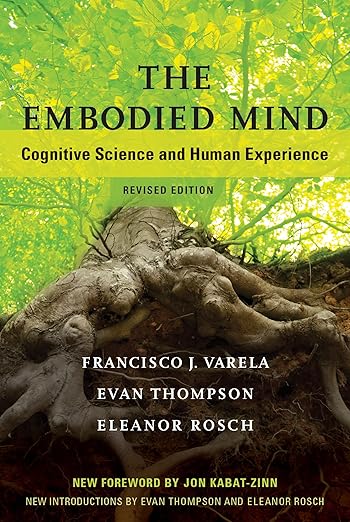
The Embodied Mind: Cognitive Science and Human Experience
This classic book, first published in 1991, was one of the first to propose the “embodied cognition” approach in cognitive science. It pioneered the connections between phenomenology and science and between Buddhist practices and science—claims that have since become highly influential. Through this cross-fertilization of disparate fields of study, The Embodied Mind introduced a new form of cognitive science called “enaction,” in which both the environment and first person experience are aspects of embodiment. However, enactive embodiment is not the grasping of an independent, outside world by a brain, a mind, or a self; rather it is the bringing forth of an interdependent world in and through embodied action. Although enacted cognition lacks an absolute foundation, the book shows how that does not lead to either experiential or philosophical nihilism. Above all, the book’s arguments were powered by the conviction that the sciences of mind must encompass lived human experience and the possibilities for transformation inherent in human experience.
Praise for The Embodied Mind
“The Embodied Mind is a thoroughly original integration of cognitive science, continental philosophy, and Buddhist thought, and in its transpersonal dimension, rather beautiful.”
— Gordon G. Globus , M.D., Professor of Psychiatry and Philosophy, University of California, Irvine
“An important book with wideranging implications for the construction of subjectivity in the Western tradition. Moreover, it is engagingly written, presenting difficult ideas and complex research programs with grace, lucidity, and style.”
— N. Katherine Hayles, American Book Review
 Evan Thompson